Sawmills make more money when they sort logs by quality, allocating high-quality logs to premium products and reducing waste. Modulai developed anautomated log quality classification system, using an inexpensive camera and computer vision to count annual rings and assess wood quality.
Outcome
90%
Classification accuracy
1s
Sub second inference
Challenge
Tracy of Sweden, a company focused on responsible value extraction from forests, sought to build a toolbox of algorithms for automatic log quality classification. Key quality aspects include annual ring density, rot, split logs, blue stain, insect damage, root flares, and cracks. These issues significantly impact the value and usability of harvested wood, leading to inefficiencies and waste in the forestry industry.
Solution
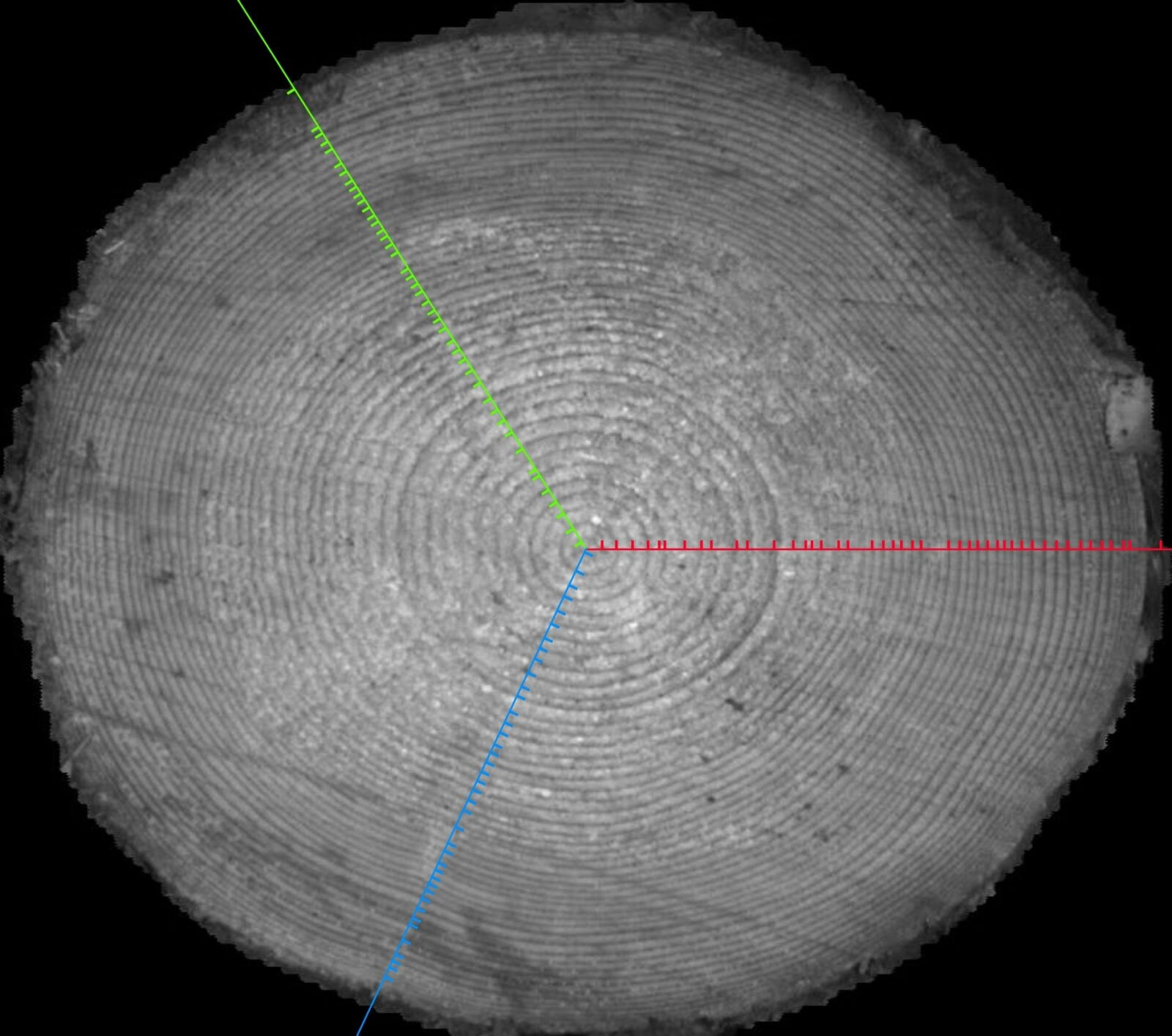
Modulai built a computer vision pipeline in several stages, focused on the highest value problem: counting annual rings to determine wood quality. First, a U-Net segmentation model isolates the cutting surface by removing the background. Second, an EfficientNet model locates the pith, the center of the log. Third, the rings are counted using two methods: one measures radial light intensity to count dark segments, the other uses a ring segmenter U-Net trained on synthetic data generated by GAN models.
Tools
The solution is built on a multi-model computer vision pipeline. A U-Net model handles log surface segmentation, an EfficientNet model performs pith detection, and a second U-Net trained on GAN-generated synthetic data segments the age rings. A complementary approach based on radial light intensity analysis provides an additional ring-counting method. All models run on standard camera-captured imagery.
Value created
The system grades log quality as accurately as a trained operator, reaching 90% accuracy within range. It runs alongside human operators to flag significant discrepancies, which speeds up sorting and cuts material waste.
Learn more